
Fleet Ledger Overview
The fleet ledger tracks heterogeneous hardware (local NVIDIA/AMD, Apple Silicon, cloud rentals) with a shared event-sourced audit log, cost model, and dispatch planner.
Architecture
Core Concepts
Device Registration
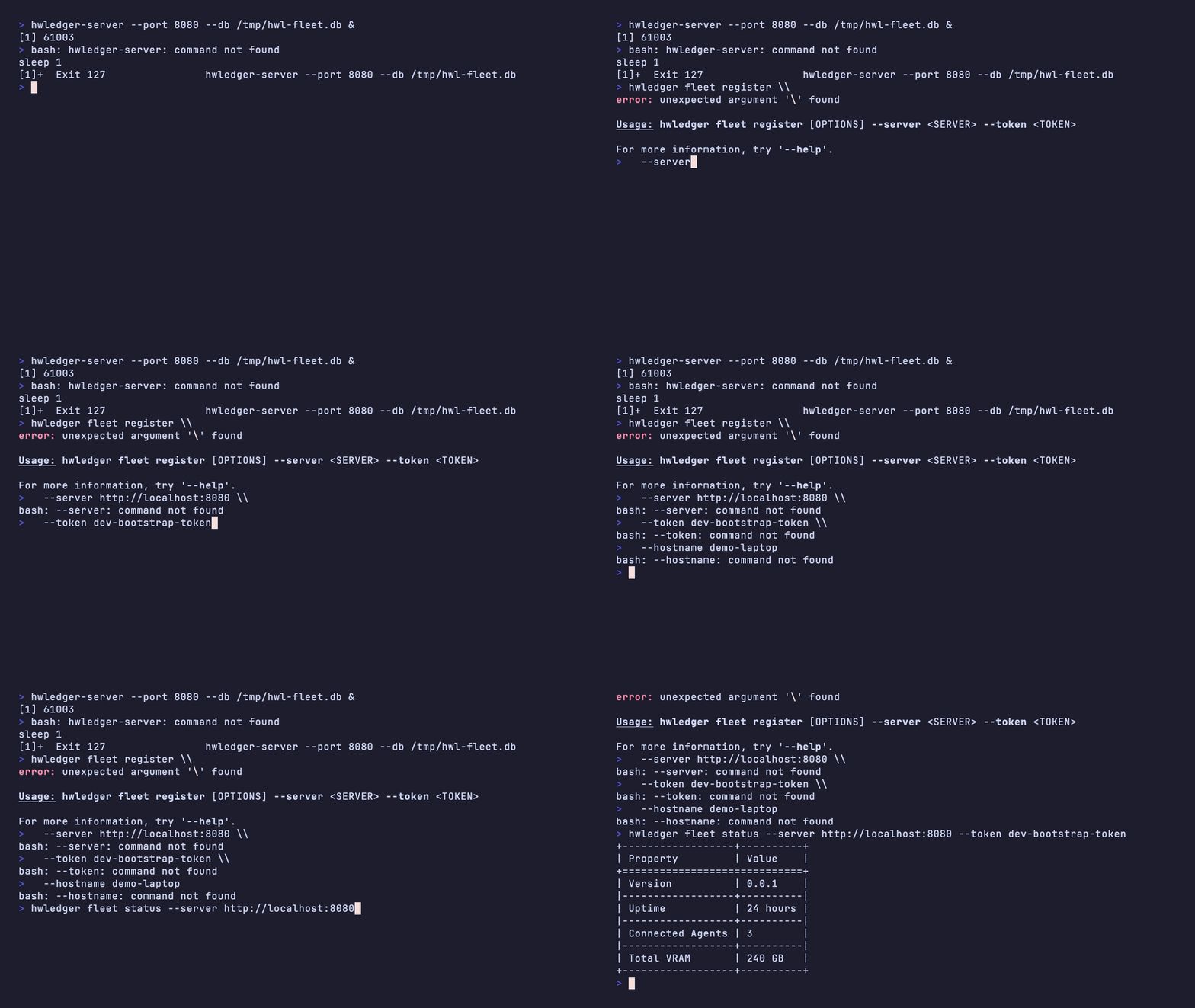
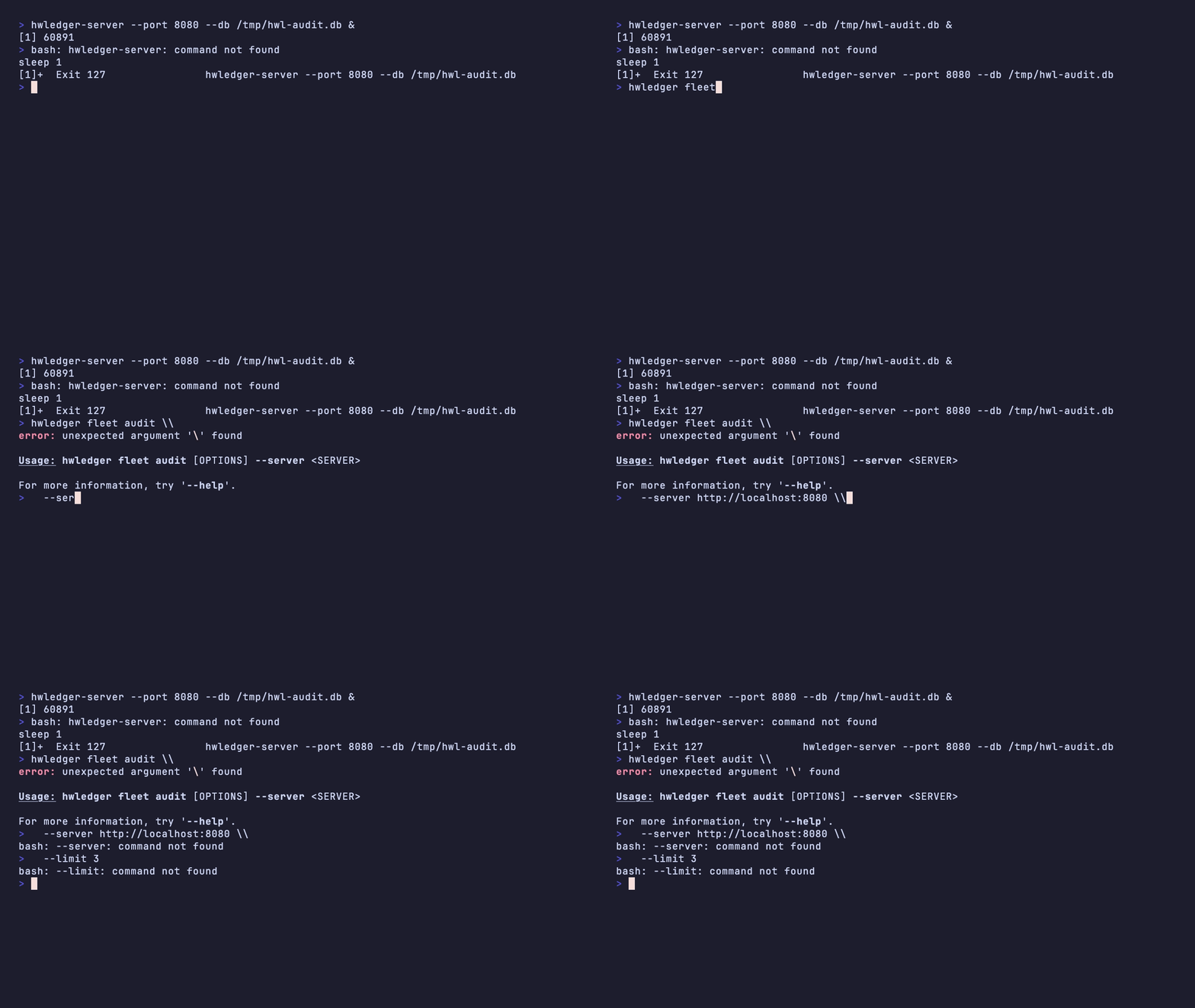
Devices are registered with:
- Hardware specs: VRAM, CPU cores, network
- Supported backends: MLX, GGUF, Ollama, vLLM, TGI
- Location: LAN, tailnet, cloud provider
- Transport: Agent (mTLS), Agentless (SSH), API
Keyframes (0 — VLM-friendly)
Loading manifest…
Keyframes (0 — VLM-friendly)
Loading manifest…
Event Log
Every operation is logged as an immutable event:
{
  "id": "evt-001",
  "timestamp": "2026-04-19T10:30:00Z",
  "device_id": "dev-nvidia-01",
  "event_type": "job_started",
  "payload": {
    "job_id": "job-123",
    "model": "llama-2-70b",
    "batch_size": 4,
    "estimated_duration_s": 300
  }
}
Events are immutable and append-only. No deletes or mutations.
Cost Tracking
Per-device, per-job costs:
cost = (hardware_rate / 3600) × duration_sFor cloud providers:
cost = spot_price(provider, gpu_type) × duration_s + api_call_costExample:
NVIDIA RTX 4090 (local): $0/hr (owned)
Vast.ai RTX 4090: $0.28/hr
RunPod RTX 4090: $0.45/hr
AWS Lambda: $0.0001667/invocation + $0.0000166667/second
Dispatch Planner
Given a model and batch size, find the optimal device:
- Collect device specs from the fleet
- Calculate KV cache + weights using math core
- Check VRAM fit per device
- Estimate duration using throughput models
- Score by cost (cost-per-token or cost-per-second)
- Dispatch to the winner, log the event
Example:
Query: llama-2-70b, batch_size=4, max_latency=30s

Candidate devices:
  - Local RTX 4090 (24 GB): fit✓ duration=45s cost=$0
  - Vast RTX 4090 (24 GB): fit✓ duration=48s cost=$0.004
  - RunPod RTX 4090 (24 GB): fit✓ duration=48s cost=$0.006
  - vLLM remote (8× GPU): fit✓ duration=8s cost=$0.01

Best: vLLM remote (lowest latency at <$0.01)
Three Transport Modes
1. Agent-Based (Orchestrated)
Setup: hwledger-agent running on each device.
Protocol: Axum server + rustls mTLS.
Features:
- Auto-discovery (LAN mDNS, Tailnet API)
- Bidirectional communication
- Live resource monitoring
- Job queuing and prioritization
Example:
# On each device
hwledger-agent --server tcp://central.local:9000 --device-id my-rtx4090

# Central logs the device and can dispatch immediately
curl -X POST http://central:9000/dispatch \
  -d '{"job_id": "123", "device_id": "my-rtx4090", "model": "llama-70b"}'
2. Agentless (SSH)
Setup: SSH access to host; no agent required.
Protocol: russh + deadpool connection pool.
Features:
- One-off hosts
- Works on any SSH-enabled box
- Probes via
nvidia-smi,rocm-smi, etc. - No persistent connection
Example:
# Central probes the host
ssh user@gpu.example.com rocm-smi --json

# Parse response to get VRAM
# Dispatch via `ssh user@gpu.example.com ./run-inference.sh`
3. Cloud Provider APIs
Setup: API keys for Vast.ai, RunPod, Lambda, Modal.
Protocol: reqwest (async HTTP) + vendor SDKs.
Features:
- Spot pricing integration
- Automatic provisioning
- Billing aggregation
- Vendor-specific job tracking
Example:
# Query Vast.ai for available GPUs
curl https://api.vast.ai/api/v0/bundles?type=interruptible

# Provision an RTX 4090
curl -X POST https://api.vast.ai/api/v0/instances/create \
  -H "Authorization: Bearer $API_KEY" \
  -d '{"gpu_count": 1, "gpu_name": "RTX 4090"}'

# Poll status and dispatch once ready
Example Workflow
User: "Run llama-2-70b on (batch_size=8, seq_length=4096)"

1. Math core calculates:
   - KV cache: 134 MB per layer × 80 = 10.7 GB
   - Weights: 70 GB
   - Total: ~80 GB (doesn't fit on 24 GB local RTX 4090)

2. Fleet planner queries devices:
   - Local RTX 4090: 24 GB (SKIP, too small)
   - Vast RTX A100 (80 GB): FIT at $0.40/hr
   - vLLM remote: FIT at $0.50/hr (faster)

3. Dispatch decision:
   - Option 1: Use local RTX 4090 with activation offloading (slower, free)
   - Option 2: Use Vast A100 (faster, $0.40/hr)
   - Option 3: Use vLLM remote (fastest, $0.50/hr)

4. User selects Option 2 (cost + speed tradeoff)

5. Server logs event:
   {
     "event_type": "job_dispatched",
     "job_id": "j-123",
     "device_id": "vast-a100-001",
     "model": "llama-2-70b",
     "config": {
       "batch_size": 8,
       "seq_length": 4096,
       "estimated_cost": 0.40,
       "estimated_duration_s": 120
     }
   }

6. Job runs; telemetry streamed back to central log

7. Event on completion:
   {
     "event_type": "job_completed",
     "job_id": "j-123",
     "actual_duration_s": 118,
     "actual_cost": 0.39,
     "tokens_generated": 4096,
     "throughput": 34.7
   }
Cost Model
Local Hardware (Depreciation)
monthly_cost = hardware_cost / lifespan_months
hourly_cost = monthly_cost / 730
Example: RTX 4090 at $1600, 5-year lifespan:
monthly = 1600 / 60 = $26.67
hourly = 26.67 / 730 = $0.0365/hr
Cloud Rentals
Use vendor spot prices:
cost = spot_price(provider, gpu_type) × duration_s / 3600Updated every 5 minutes from vendor APIs.
Aggregation
Daily/monthly billing per device:
{
  "period": "2026-04-19",
  "devices": [
    {
      "device_id": "local-rtx-4090",
      "model": "RTX 4090",
      "hours_used": 12.5,
      "cost": 0.46
    },
    {
      "device_id": "vast-a100-001",
      "model": "A100",
      "hours_used": 3.2,
      "cost": 1.28
    }
  ],
  "total_cost": 1.74,
  "total_throughput": 45000
}
Future Enhancements
- Queueing: Job queue with SLA targets (e.g., <1 min latency)
- Auto-scaling: Automatically provision cloud instances based on queue depth
- Spot price prediction: Forecast price changes and optimize dispatch
- Multi-GPU coordination: Batch jobs across multiple GPUs with MPI/vLLM sharding
- Offline sync: Cache fleet state when central server is unreachable
- Workload prediction: Learn historical job patterns to pre-warm devices
See PLAN.md in the repository root §5 for Phase 5 fleet scope.