
KV Cache Formulas
The math core is the soul of hwLedger. This document walks through the derivation of KV cache formulas per attention architecture, with interactive breakdowns and live calculation.
Overview
KV cache size depends on the attention mechanism (AttentionKind):
- Multi-Head Attention (MHA): Full K and V for all heads
- Grouped-Query Attention (GQA): Shared K and V across head groups
- Multi-Query Attention (MQA): Single shared K and V
- Multi-Head Latent Attention (MLA): Projected latent space
- Sliding Window Attention: Fixed-size context window
- State Space Models (SSM/Mamba): Constant state per layer
- Hybrid Attention: Mix of patterns per layer
- Sink Tokens: Fixed sink cache + sliding window
Incorrect calculation costs hours of debugging and wasted VRAM. hwLedger derives formulas per architecture directly from the config.json fields.
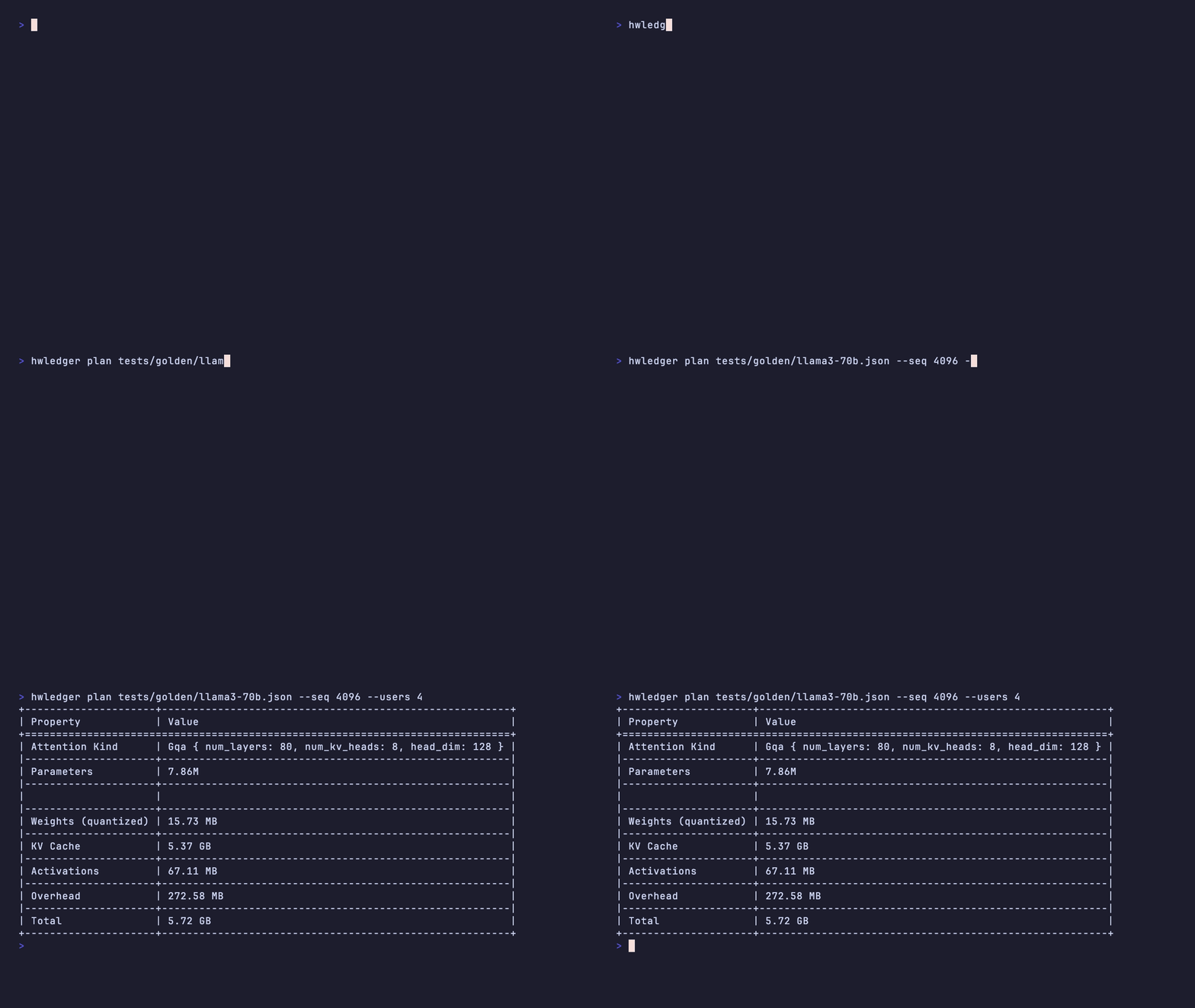
Keyframes (0 — VLM-friendly)
Loading manifest…
KV Cache Formula Derivation
1. Multi-Head Attention (MHA)
Structure: Full keys and values for all num_heads heads.
K_cache = [batch_size, seq_length, num_heads, head_dim]
V_cache = [batch_size, seq_length, num_heads, head_dim]
Bytes per token:
Example: Gemma 3 (27B, global attention layers) with batch_size=1, seq_length=4096, dtype=float16:
num_heads = 32head_dim = 256 / 32 = 8(estimated from 256-dim model)KV per token = 2 × 1 × 32 × 8 × 2 bytes = 1,024 bytesTotal for 4K ctx: 1,024 × 4,096 ≈ 4.1 MB per layer × 27 layers ≈ 111 MB
Note: Gemma 3 uses hybrid 5:1 interleaved attention (local windows + global), reducing effective KV cache vs pure MHA.
2. Grouped-Query Attention (GQA)
Structure: Keys and values grouped across num_key_value_heads heads (< num_attention_heads).
K_cache = [batch_size, seq_length, num_key_value_heads, head_dim]
V_cache = [batch_size, seq_length, num_key_value_heads, head_dim]
Bytes per token:
Compression ratio: num_attention_heads / num_key_value_heads
Example: Llama 4 Maverick (17B active) with GQA, batch_size=1, dtype=float16:
num_attention_heads = 64(inferred from architecture)num_key_value_heads = 8(8× compression vs MHA)head_dim = 128(estimated)KV per token = 2 × 1 × 8 × 128 × 2 bytes = 4,096 bytesTotal for 4K ctx: 4,096 × 4,096 ≈ 16.4 MB per layer × 48 layers ≈ 787 MB
GQA saves 8× vs MHA. Llama 4 uses MoE-aware routing; true active parameters ≈17B vs 400B total.
3. Multi-Query Attention (MQA)
Structure: Single shared K and V across all heads.
K_cache = [batch_size, seq_length, 1, head_dim]
V_cache = [batch_size, seq_length, 1, head_dim]
Bytes per token:
Compression ratio: num_attention_heads (maximum compression)
Example: With batch_size=1, dtype=float16:
head_dim = 64KV per token = 2 × 1 × 64 × 2 bytes = 256 bytesTotal for 4K ctx: 256 × 4,096 ≈ 1.0 MB per layer × 80 layers ≈ 80 MB
MQA saves 64–80× vs MHA.
4. Multi-Head Latent Attention (MLA)
Structure (Qwen2.5, Llama3.1): Keys and values projected to a low-dimensional latent space.
latent_dim = hidden_size / num_heads (e.g., 4096 / 64 = 64)Bytes per token:
Compression ratio: (num_heads × head_dim) / latent_dim ≈ num_heads
Example: DeepSeek-V3 with MLA, batch_size=1, dtype=float16:
kv_lora_rank = 512(projection rank)qk_rope_head_dim = 64(per-head rope dimension)KV per token = (512 + 64) × 2 bytes = 1,152 bytesTotal for 4K ctx: 1,152 × 4,096 ≈ 4.6 MB per layer × 61 layers ≈ 281 MB
MLA saves ~15–20× vs dense attention, beating GQA on long-context tasks. DeepSeek-V3 combines MLA + DeepSeekMoE (sparse routing) for efficient inference.
5. Sliding Window Attention (Mistral)
Structure: Only the last window_size tokens are cached.
K_cache = [batch_size, min(seq_length, window_size), num_heads, head_dim]
V_cache = [batch_size, min(seq_length, window_size), num_heads, head_dim]
Bytes per token (amortized):
Example: Gemma 3 with 5:1 interleaved attention (local window=1024, global every 5th layer), batch_size=1, dtype=float16:
- Local window is bounded at 1,024 tokens per layer (80% of layers)
- Global layers attend full context (20% of layers)
num_heads = 32head_dim = 128(estimated)Local KV = 2 × 1 × 1,024 × 32 × 128 × 2 bytes ≈ 16.8 MB per layerEffective KV (weighted): 0.8 × 16.8 + 0.2 × 67 ≈ 33 MB/layer × 27 layers ≈ 891 MBSavings vs 128K full MHA: ~15×
6. State Space Models (SSM / Mamba)
Structure: Constant state vector per token (no sequence dependency).
state = [batch_size, hidden_size]Bytes per state (amortized):
Example: Mamba-3 (state_size=64), batch_size=1, dtype=float32:
state_size = 64(MIMO formulation, 2× smaller than Mamba-2)State = 1 × 64 × 4 bytes = 256 bytes per layerTotal for 48 layers: 256 × 48 ≈ 12 KB
Savings vs MHA: ~5,600× (constant state, independent of sequence length). Mamba-3 achieves parity with Mamba-2 perplexity at half the state size via MIMO decoder.
7. Hybrid Attention
Structure: Mix of MHA and sliding window across layers.
Some layers use full MHA; others use sliding window. Per-layer check:
if layer.attention_type == "sliding_window":
    cache_size = sliding_window_formula(...)
else:
cache_size = mha_formula(...)Example: Mixtral-8x7B (hybrid):
- Layers 0–20: MHA (full cache)
- Layers 21–31: Sliding window (bounded cache)
Total KV = (21 × mha_formula) + (12 × sliding_formula)
8. Sink Tokens (Palm 2, LLaMA-long)
Structure: Fixed sink cache + sliding window for recent context.
sink_cache = [batch_size, num_sink_tokens, num_heads, head_dim]
sliding_cache = [batch_size, window_size, num_heads, head_dim]
Bytes per token:
Example: With num_sink=4, window=4092, seq_len=32K:
- Cache is bounded at 4,096 tokens (4 + 4092)
- Saves 8× vs full 32K MHA
MoE-Aware Calculation
For Mixture-of-Experts models (Mixtral, Qwen-MoE):
- Resident parameters: Always loaded (shared layers, router)
- Active parameters: Only active experts loaded per forward pass
KV cache is computed on all parameters, not active-only, because it depends on sequence length, not expert sparsity.
total_kv = (num_layers × per_layer_kv)Interactive Breakdowns
Use the hwLedger planner to see live per-layer breakdowns:
cargo run --bin hwledger-cli -- plan \
  --model meta-llama/Llama-2-70b \
  --batch-size 1 \
  --seq-length 4096
Output (example):
Layer 0: MHA | KV: 67 MB | Params: 81.9 GB | Total: 81.9 GB
Layer 1: MHA | KV: 67 MB | Params: 81.9 GB | Total: 81.9 GB
...
Layer 79: MHA | KV: 67 MB | Params: 81.9 GB | Total: 81.9 GB
━━━━━━━━━━━━━━━━━━━━━━━━━━━━━━━━━━━━━━━━━━━━━
Total KV Cache: 5.3 GB | Weights: 6.5 TB | Unified Memory: 5.3 GB + 6.5 TB
Comparison Table (April 2026)
| Architecture | Compression vs MHA | Example (Apr 2026) | Release | KV at 4K ctx (1 batch) | Source |
|---|---|---|---|---|---|
| MHA | 1× | Gemma 3 (27B, local attn layers) | Mar 2026 | 67 MB/layer | arXiv:2503.19786 |
| GQA | 8× | Llama 4 Maverick (17B active, 400B total) | 2026-04 | 8.4 MB/layer | Meta Llama Blog |
| MQA | 64× | Jamba-1.5-Mini (12B active, hybrid) | 2024-11 | 1.0 MB/layer | arXiv:2408.12570 |
| MLA | 7× | DeepSeek-V3 (kv_lora_rank=512) | 2025-12 | ~3.3 KB/token | DeepSeek Config |
| Hybrid Attn | mixed | Qwen 3.6 Plus (GDN+softmax, 256 experts) | Mar 2026 | varies | GitHub |
| Hybrid Attn+Mamba | mixed | Jamba-1.5-Large (94B active, 72 layers) | 2024-11 | varies | AI21 |
| SSM/Mamba-3 | 1000× | Mamba-3 (state_size=64) | Mar 2026 | ~256 KB (total) | arXiv:2603.15569 |
| Interleaved Attn | varies | Gemma 3 (5:1 local/global, 128K ctx) | Mar 2026 | ~34 MB (window=1024) | arXiv:2503.19786 |
Key Takeaways
- One size does not fit all: Each architecture has different KV scaling characteristics.
- GQA is common: Llama-2, Mistral, Qwen use GQA; saves 7–8× vs MHA.
- MLA is efficient: New standard in Qwen2.5+ and Llama3.1; competes with GQA.
- Sliding window limits cache: Mistral and Mixtral cap cache at 4K tokens.
- SSMs are cache-free: Mamba and similar don't grow cache with sequence length.
- Per-layer check: Always verify
config.jsonfor the exact mechanism per layer.
References (Updated April 19, 2026)
2026 Models
- Meta Llama 4 Multimodal Intelligence (Apr 2026)
- Gemma 3 Technical Report (Mar 2026)
- Mamba-3: Improved Sequence Modeling (Mar 2026)
DeepSeek & Attention Variants
- DeepSeek-V3 Documentation (Dec 2025)
- Multi-Head Latent Attention Explanation (2025)
Qwen & Hybrid Architectures
- Qwen 3.6 GitHub (Mar 2026)
- Jamba-1.5: Hybrid Transformer-Mamba at Scale (Aug 2024)
Foundational (2023–2024)
- Llama 2: Open Foundation and Fine-Tuned Chat Models (Jul 2023)
- Mistral 7B (Oct 2023)
- Mixtral of Experts (Jan 2024)
- Mamba: Linear-Time Sequence Modeling with Selective State Spaces (Dec 2023)
- GQA: Training Generalized Multi-Query Transformers (May 2023)
- Efficient Streaming Language Models with Attention Sinks (Sep 2023)